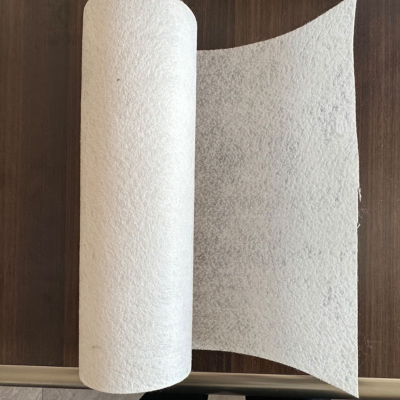
Filament Non-Woven Geotextile
Filament Non-Woven Geotextile is manufactured using continuous polyester (PET) or polypropylene (PP) filaments through advanced thermal bonding or needle-punching processes. Its unique filament structure forms a uniform three-dimensional porous network, combining high tensile strength with superior water permeability. Compared to staple fiber non-woven geotextiles, the continuous filaments significantly enhance mechanical integrity, resist delamination or deformation, and are ideal for high-load engineering applications.
Core Functions & Advantages
High Strength & Durability: The filament structure provides exceptional tensile and puncture resistance (tensile strength: 20–100 kN/m) and minimal creep under sustained loads, making it suitable for heavy-duty environments like roadbed reinforcement and landfill base protection.
Efficient Filtration & Drainage: Uniform pore structure (pore size: 80–200 μm) effectively retains fine soil particles while maintaining high permeability (vertical permeability coefficient ≥0.1 cm/s), preventing clogging and accelerating water discharge.
Chemical Resistance: Resists acids, alkalis, and microbial degradation, ideal for contaminated soil remediation or industrial wastewater treatment facilities.
Eco-Friendly & Cost-Effective: Recyclable design reduces material waste, while easy installation lowers overall project costs.


Typical Applications
Transportation Infrastructure: Separation layers for road/railway subgrades to distribute loads and prevent soft soil settlement.
Environmental Engineering: Leachate drainage layers in landfills, protective layers for artificial lake liners.
Hydraulic & Municipal Projects: Filtration systems for riverbank slope protection, wrapping for underground drainage pipelines.
Disaster Prevention: Buffer layers for debris flow control, emergency reinforcement for temporary flood barriers.
Summary
Filament Non-Woven Geotextile, leveraging the mechanical advantages of continuous filaments and the permeability of non-woven technology, is the go-to material for demanding engineering projects. It balances strength, durability, and ecological benefits, delivering reliable solutions for modern infrastructure development.